Chacking Birds and White Bums!
Isn’t it great, we are now getting some sunny days and the world seems a little better as a consequence, especially if we ignore the news. Okay, not every day’s been brilliant but at least we can get out and about without getting too wet, appropriate clothing included of course. Did you know How Stean has a bunkbarn up at Scar House and Scar House is also a good place, during April, to see some early spring migrants. A couple of bird watchers’ favourite birds, both early visitors, can be seen up there, the ring ouzel, also known as the mountain blackbird, and the Wheatear.
Ring ouzels are very similar to blackbirds, only slightly bigger with a necklace or crescent of white and unless on passage they are only found on the high ground, frequently in places where blackbirds fear to venture. I suspect blackbirds are fairly fearless yet they rarely go to the altitude enjoyed by ring ouzels. Like blackbirds, ring ouzels are sexually dimorphic. Sexual dimorphism is the condition where the two sexes of the same species exhibit differ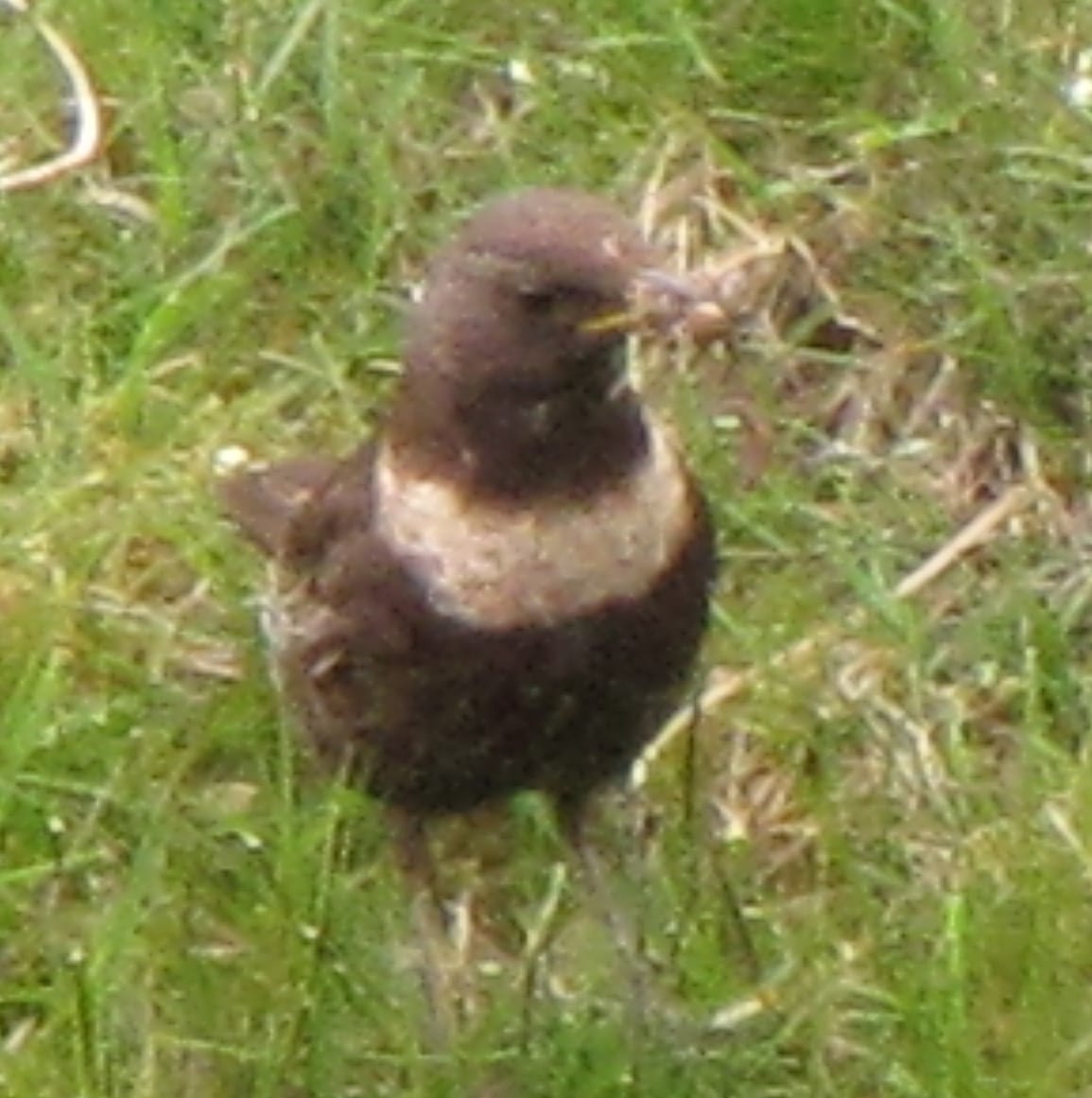 ent characteristics beyond the differences in their sexual organs. Males are black, females brown, probably because females spend much of their time on the nest whilst males need to attract the females and spend much of their time providing for the hen and their brood. Scar House is a favourite and well known place for birders to come to see ring ouzels and they usually aren’t disappointed, despite the fact that ring ouzels have declined by 58% between 1988-91 to 1999. Further fieldwork in 2012 found that numbers had decreased by 72% since 1988-91, making the ring ouzel a red data bird, see BTO Bird Trends. Now ring ouzels seem to enjoy life amongst the rocky areas south of the car park at Scar House but they usually need searching for. They aren’t easy to find but with the patience of a saint and the luck of the Irish you should see them. Ring ouzels (Turdus torquatus) belong to the thrush family, turdus together with torque, neck ring. The male sings its loud and mournful song from trees or rocks. This leads to it getting the old Scots name of aiten chackart (ie chat of the juniper; aitionn = Gaelic for juniper; chackart = Scots for chacking bird). Continental birds tend to nest in trees whilst our birds seem to prefer ground nesting, this could well be the beginnings of the start of a new species, read the How Stean Blog in 1,000 years’ time to see how they are progressing. The main food source for our breeding birds is earthworms, and ring ouzels are migrants, they spend their winters in mainly North Africa, making them relatively short-distance migrants and consequently early arrivals in spring.
The other iconic early arrival to our shores and uplands is the wheatear, so called because of its white rump, although there are those who prefer a cruder description, a 16th-century linguistic corruption of “white” and “arse”. Wheatear (Oenanthe oenanthe) were once considered like ring ouzels to be part of the thrush family but are now thought more likely to be part of the flycatcher brigade. Oenanthe apparently refers to the wheatears’ return to Ancient Greece just as the grapevines blossom and wheatear has nowt to do with ears of wheat. Most species have characteristic black and white or red and white markings on their rumps or their long tails. The wheatear is a small mainly ground-dwelling bird. It hops or runs on the ground. It is blue-grey above with black wings and white below with an orange flush to the breast. The male has a black cheek and white eye stripe. In flight it shows a white rump and a black ‘T’ shape on its tail. It is a summer visitor and passage migrant. Again the species is sexually dimorphic with the female being duller although still sporting the diagnostic white rump. Wheatears can be quite numerous and confiding, especially on limestone areas such as around Malham Cove. They are less numerous in Nidderdale but can still be found at Scar House and probably more easily than ring ouzels. Interestingly, as the ice retreated northwards after the last ice-age, the breeding grounds of the migrant wheatear shifted northwards, the birds migrating back to Africa, even those that now breed in Alaska. Wheatears are not considered to be under threat anywhere within their range and strictly speaking we should refer to our wheatears as northern wheatears so as not to confuse them with other worldwide species of wheatears. So next time you visit Scar House keep an eye open for these early migrants, you won’t be disappointed.
Nigel Heptinstall (Outdoors2015)

