Spring Has Sprung
 Well it’s certainly starting to uncoil, especially regarding birds. I spent a day in Upper Nidderdale and was pleasantly surprised at what was about. Maybe you might find time to do the same, but I suggest you choose a dry windless day if that is ever possible at Scar House. Anyway we started at Gouthwaite and looked from the viewing area. There seemed to be more mud than usual and I attribute that to whatever work is being undertaken on the dam wall. You might know what is happening, I don’t. Mud is of course brilliant for many birds, but especially for waders because it allows them to probe deep for invertebrates. When I say probe deep I recognise that the length of the bill plays an important part in how deep you can probe and it’s understood that different beak lengths allow different birds to eat from different strata and therefore don’t compete with each other. I’m never one hundred percent sure about this but I’m no scientist and it’s the scientists who determined this. In my view if you have a beak then you can probe anywhere between the surface and the total beak length, which means if you have a longer beak you have a greater area to search, what do you think? What is for sure is that soft mud is better than frozen or hard mud, at least as far as probing is concerned.
Enough about beaks, we recorded around 35 species at Gouthwaite including waders such as lapwing, curlew, oystercatcher, dunlin, ringed plover and redshank. In fact it’s many years since I have seen so many redshank together. I would estimate there may have been as many as 30, usually I feel privileged to see one or two. We can only guess at what these birds were doing there but the probability is that some were planning to breed locally but others may well have dropped off to feed up before moving further north, most likely to Iceland where many redshank breed. Redshank are of Conservation Status AMBER because they have suffered recent population declines. For full details visit the BTO Redshank Fact File. Another interesting bird sighting was my first sand martins of the spring and they were seen in good numbers, so it’s likely that the new sand martin wall near Ramsgill will receive plenty of visitors this summer. There were also plenty of duck species present including mallard, tufted, goldeneye (soon to leave us), goosander and shelduck. If you are new to birding and want to learn the different species then grab a bird book or phone app, a pair of binoculars and see what you can see, now’s a great time of year to do it.
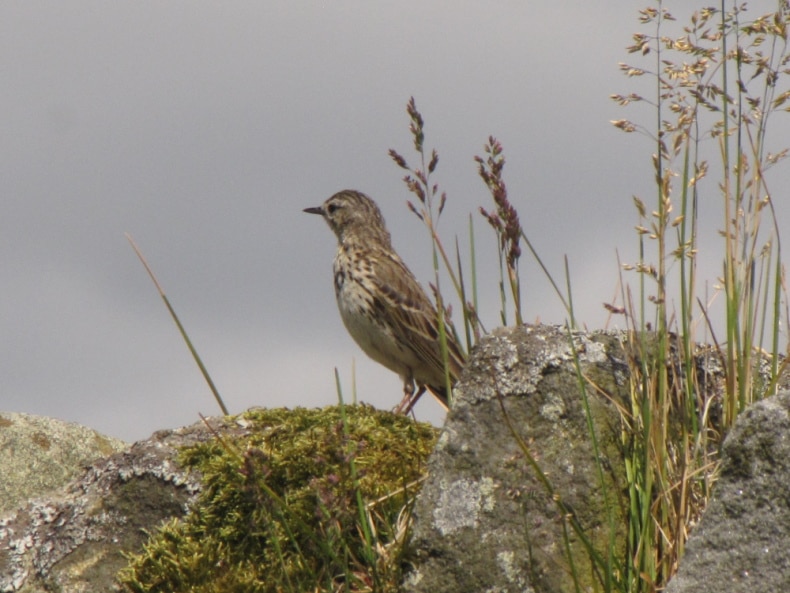
Don’t however restrict yourself to Gouthwaite, drive up to Scar House, park in the car park there and look for the birds there and you may well be rewarded with some more unusual species, from the car park – perhaps even from your car – if it’s very wet or windy and it often is. Search for the spring migrants. There are not too many birds around here in winter but now spring has arrived a few birds have returned and a special one is the ring ouzel, the mountain blackbird. Superficially similar to the blackbird and probably a species that has only recently in evolutionary terms separated from the blackbird, unlike the blackbird both males and females sport a crescent of white across their breast, more subdued in the females, called a gorget. You can find more info about ring ouzels on the RSPB ring ouzel page. To see these birds once in the car park scan the area of hillside in front of the car park. They are well camouflaged so look carefully and be patient although some say that they appear at 1pm in a tree towards the top of the hillside. If you stand with your back to the car park and look towards 10 o’clock you’ll see the tree towards the top of the hill. Personally I wouldn’t rely upon this but it’s a start! Also back are meadow pipits, the ubiquitous LBJ, little brown job of the hills, they can be everywhere in summer and are often seen ‘parachuting’ down from a height as part of their courtship display. Finally another summer migrant to search for here is the wheatear, a delightful bird which lives and feeds amongst the rocks and is recognised by its white rump when it flies away.
Enjoy your birding.
Nigel Heptinstall (Outdoors2015)

